“Tai Chi and Dissolving Anxiety: Learning to Quiet the Mind Through Movement”
Anxiety often begins in the mind, but very quickly it is felt throughout the body. The breathing becomes shorter, muscles tighten, thoughts accelerate, and we may feel unable to switch off. We start thinking about what could happen tomorrow, replaying what happened yesterday, and gradually lose our connection with what is happening right now.
Tai Chi offers a different approach. Instead of trying to fight anxious thoughts, we bring our attention back into the body. Through slow movement, relaxed breathing, and focused awareness, Tai Chi creates the conditions in which the mind can gradually become quieter.
Research increasingly supports Tai Chi as a useful complementary practice for reducing stress and anxiety symptoms. A 2023 systematic review and meta-analysis involving 23 randomized studies found that Tai Chi produced a small-to-moderate improvement in anxiety compared with forms of exercise that did not specifically incorporate mindfulness. (PubMed)
Anxiety Takes Us Into the Future — Tai Chi Brings Us Back to Now
Anxiety is frequently connected with anticipation: What will happen? What if something goes wrong? What if I cannot manage it?
Tai Chi continuously asks us to return our attention to something much simpler: Where is my body now? Where is my weight? How am I breathing? Where is the tension?
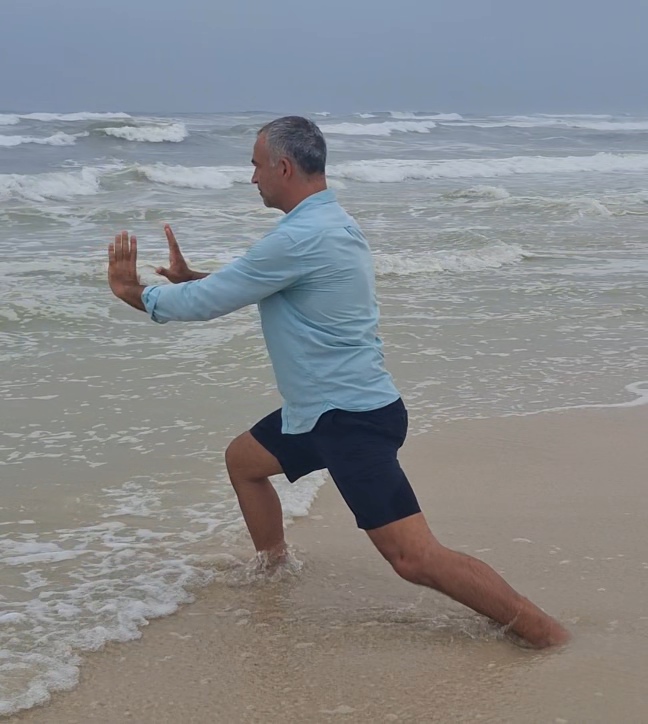
When we practice a movement slowly, attention must remain with the movement. We begin noticing the feet touching the ground, the transfer of weight from one leg to another, the position of the hands, and the rhythm of the breath.
The mind has less space to continuously follow the same anxious thought patterns.
This may be one reason Tai Chi appears to offer psychological benefits beyond movement alone. A 2023 meta-analysis comparing Tai Chi with non-mindful exercise found significant benefits for anxiety, depression, and general mental health, although the researchers also emphasized that more high-quality studies are needed. (PubMed)
Tai Chi becomes, in this sense, meditation in movement.
Relax the Body and the Mind Can Follow
When anxiety is present, many people try to solve it entirely through thinking. But sometimes thinking about anxiety simply creates more thinking.
Tai Chi approaches the problem from the other direction.
We first work with the body.
We soften the shoulders.
We release unnecessary muscular tension.
We allow the breathing to become natural.
We slow down the movement.
We reconnect with the ground.
A 2024 systematic review and meta-analysis examined 11 randomized controlled trials involving 1,323 participants. Tai Chi showed a significant reduction in perceived stress, and analysis of five trials measuring anxiety also found a significant improvement in anxiety symptoms. (SpringerLink)
The important lesson is that relaxation is not simply an intellectual decision. It is something that can be practiced physically.
Over time, the practitioner learns to recognize tension earlier and release it before it grows.
Tai Chi Is a Practice, Not a Quick Fix
One Tai Chi class may leave you feeling calmer, but the deeper benefits come through consistency.
Research included in the 2024 stress review involved Tai Chi programs lasting approximately 8 to 24 weeks, generally practiced between one and five times per week. The researchers found that reductions in perceived stress could still be detected at follow-up, although they also noted limitations in study quality and variation between programs. (SpringerLink)
This is why at Ki Train we look at Tai Chi as a long-term practice rather than simply an exercise class.
Through regular training we learn something extremely valuable: we do not have to react immediately to everything happening inside our mind.
A thought can appear without controlling us.
A worry can appear without becoming our entire reality.
Tension can arise, and we can learn to dissolve it.
The objective is not to create a life in which anxiety never appears. The objective is to develop greater awareness, relaxation, and control over where we place our attention.
And sometimes the simplest place to begin is with one slow movement, one relaxed breath, and one moment of complete attention.
Start practicing Tai Chi with Ki Train and discover how slowing down your body can help quiet the mind.
Studies & References
- Yin et al. (2023) — Tai Chi versus non-mindful exercise for anxiety, depression and mental health
- Kraft, Waibl & Meissner (2024) — Stress reduction through Taiji: systematic review and meta-analysis
- Kuang et al. (2024) — Effects of different types of Tai Chi on anxiety and depression in older adults
- Zheng et al. — Twelve weeks of Tai Chi practice and anxiety in stressed but healthy adults
Tai Chi can be a valuable complementary practice for well-being and anxiety management, but persistent or severe anxiety should also be discussed with an appropriate healthcare or mental-health professional.