Benefits of Standing Qigong Exercises
Discovering strength, balance, and inner peace through the art of standing still.
In our modern world, we associate progress with movement, effort, and constant activity. We believe that achieving more requires doing more. Yet, ancient Chinese wisdom offers a different perspective: sometimes, the greatest transformation happens when we stop moving.
Standing Qigong, traditionally known as Zhan Zhuang (站桩), or “Standing Like a Tree,” is one of the most profound practices in Chinese internal arts. Although it appears remarkably simple, standing in a relaxed and balanced posture can become a powerful exercise for developing physical strength, mental clarity, and emotional stability.
Build Strength Without Excessive Effort
Unlike conventional exercises that rely on repetitive muscular contractions, Standing Qigong develops strength through postural alignment, gentle muscular engagement, and sustained awareness.
As we maintain a standing posture, our body learns to distribute weight efficiently, activating the stabilizing muscles of the legs, hips, back, and abdomen.
Over time, this practice can improve muscular endurance, balance, and postural control without requiring intense physical movement.
The secret is not to become stronger by creating more tension, but to become more efficient by eliminating unnecessary tension.
Activate the Body’s Natural Relaxation Response
One of the greatest benefits of Standing Qigong is its ability to teach the nervous system how to relax while remaining alert.
Most people carry unnecessary tension in their shoulders, neck, lower back, and facial muscles. Often, this tension becomes so familiar that we no longer recognize it.
During standing practice, we gradually become aware of these unconscious muscular contractions and learn to release them.
Combined with natural breathing, this process may reduce perceived stress and promote a calmer physiological state.
This is what we call Active Relaxation, the first pillar of the Ki Train Method.
Improve Energy Efficiency
Imagine a tree standing effortlessly through changing seasons. It does not waste energy fighting gravity. Its stability comes from its structure.
Our body can learn the same principle.
Standing Qigong teaches us to align our skeleton, relax unnecessary muscular effort, and maintain stability with greater efficiency.
In traditional Chinese medicine, this process is described as supporting the harmonious circulation of Qi, our vital energy.
From a modern perspective, we can understand it as improving body awareness, coordination, and the economical use of muscular effort.
Energy efficiency means achieving more while consuming less.
Train the Mind and Master Attention
Standing still may appear easy, but maintaining conscious awareness without distraction is surprisingly challenging.
As the body becomes quiet, the mind reveals its constant activity: thoughts, emotions, impatience, and the desire to move.
Instead of fighting these experiences, we learn to observe them without reacting.
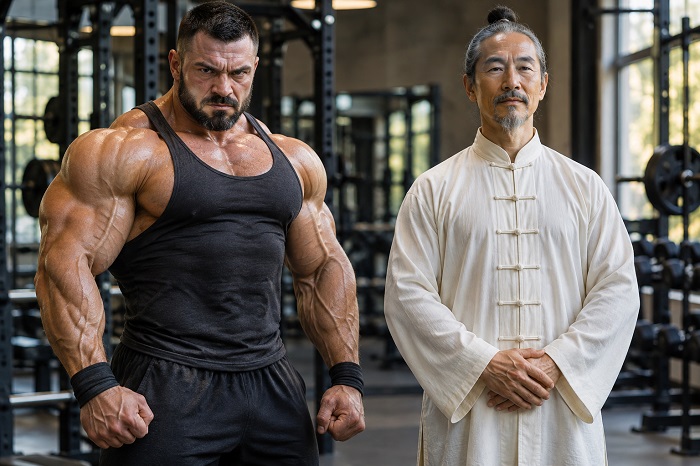
Every minute of conscious standing becomes an opportunity to develop patience, concentration, and emotional self-regulation.
This directly supports the third pillar of the Ki Train Method: Mastering Attention.
Reconnect Body and Mind
Perhaps the most valuable benefit of standing Qigong is the restoration of communication between body and mind.
We begin to recognize subtle changes in breathing, posture, muscular tension, and emotional states.
This awareness creates an opportunity to respond consciously rather than react automatically.
Standing practice becomes more than physical exercise. It becomes a method of self-discovery.
The Ki Train Perspective
At Ki Train, we believe that true transformation does not necessarily come from increasing effort. It comes from improving the quality of our awareness.
Standing Qigong brings together the three fundamental pillars of the Ki Train Method:
Active Relaxation • Energy Efficiency • Mastering Attention
Start with five minutes daily. Stand comfortably, soften your knees, relax your shoulders, breathe naturally, and observe yourself without judgment. Gradually increase the duration as your comfort and endurance improve.
The scientific evidence for specific health outcomes of standing-only Qigong remains limited, but its principles of gentle movement, balance training, and mindful attention offer a promising foundation for daily wellbeing.
Remember:
Stillness is not the absence of activity.
It is the presence of awareness.