Modern life often leaves us feeling tired, overstimulated, and disconnected from our bodies. We may sleep, take breaks, or go on holiday, yet still feel that our energy has not fully returned.
Qi Gong offers a different approach to vitality. Rather than forcing the body to produce more energy, it teaches us how to reduce unnecessary tension, breathe more efficiently, calm the mind, and use our existing energy wisely.
The word Qi refers to vital energy or life force, while “Gong” means a skill developed through consistent practice. Qi Gong can therefore be understood as the practice of cultivating, regulating, and strengthening the energy that supports our physical, mental, and emotional well-being.
What Does Vitality Really Mean?
Vitality is not simply having enough physical energy to complete daily tasks. It is the feeling of being fully alive, present, clear, and connected.
A person with strong vitality may still experience challenges or tiredness, but they recover more easily. Their body feels responsive, their mind is clearer, and their emotions are more balanced.
True vitality includes the following:
- Physical strength and mobility
- Mental clarity and concentration
- Emotional stability
- Healthy breathing and circulation
- The ability to recover from stress
- A sense of enthusiasm and connection to life
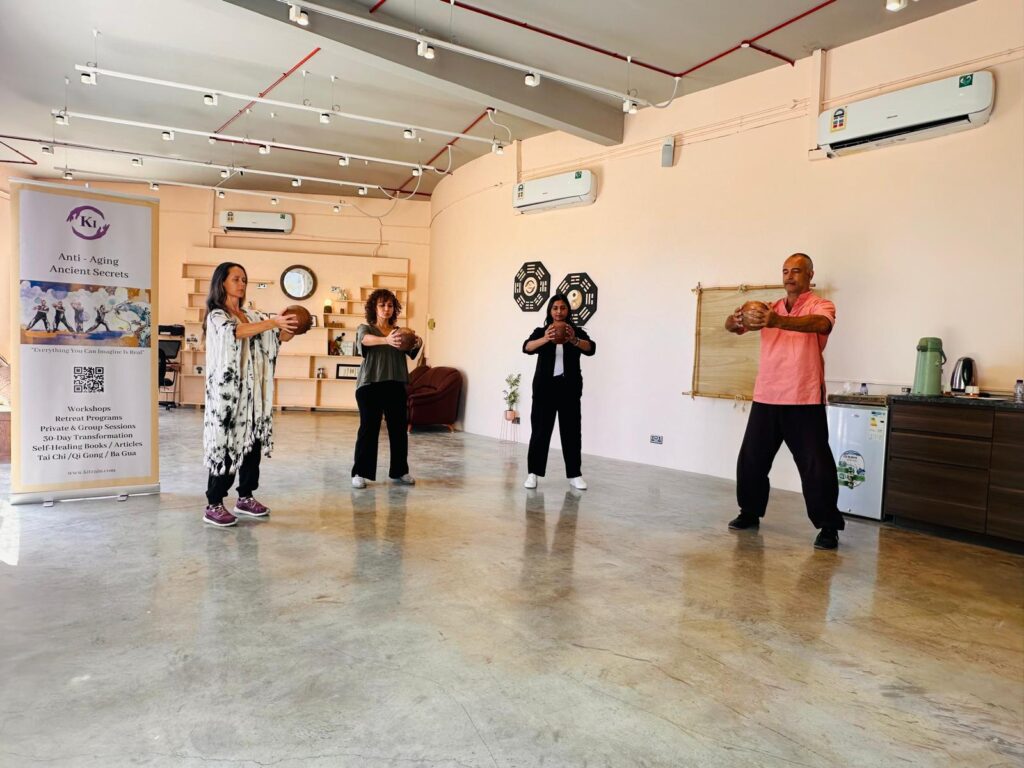
Qi Gong supports these qualities by creating harmony between the body, breath, mind, and energy.
Releasing the Tension That Drains Energy
One of the greatest causes of low vitality is unnecessary tension.
Many people spend the day with raised shoulders, a tight jaw, restricted breathing, or tension in the lower back. The body may remain in this condition even when the person is sitting or trying to rest.
This constant muscular and emotional tension consumes energy.
Qi Gong movements are generally slow, smooth, and controlled. They encourage the joints to open, the muscles to soften, and the body to move without excessive effort. As tension decreases, energy that was previously being wasted becomes available again.
Relaxation in Qi Gong does not mean becoming weak or passive. It means removing unnecessary effort so that the body can function more efficiently.
Breathing as a Source of Vitality
Breathing is central to Qi Gong practice.
When people feel stressed, anxious, or exhausted, their breathing often becomes shallow and irregular. This can reinforce tension and make the nervous system feel even more unsettled.
Qi Gong encourages calm, natural breathing coordinated with gentle movement. As the breath becomes deeper and smoother, the body begins to relax.
Conscious breathing may support better circulation, greater body awareness, improved concentration, and a stronger sense of emotional stability.
The breath also creates a bridge between the body and the mind. When the breath is rushed, the mind often feels rushed. When breathing becomes calm and steady, the mind usually begins to settle as well.
Calming the Mind and Gathering Attention
Mental activity can consume a great deal of energy.
Constant planning, worrying, remembering, and reacting can leave a person feeling exhausted even when they have not been physically active. The mind becomes scattered, moving from one thought to another without rest.
Qi Gong trains attention through movement, breathing, posture, and internal awareness. During practice, the mind is invited to remain with the present moment.
The practitioner may focus on the feeling of the feet on the ground, the movement of the hands, the rhythm of the breath, or sensations within the body.

This focused attention helps gather mental energy. Instead of being scattered in many directions, the mind becomes more stable and centered.
A calmer mind supports vitality because it reduces internal noise and allows the body to recover more effectively.
Improving Body Awareness
Many people only notice imbalance when it becomes painful or overwhelming. They may ignore tiredness, stiffness, shallow breathing, or emotional tension until the body can no longer compensate.
Qi Gong develops sensitivity to smaller changes.
Through regular practice, a person may begin to notice where they hold tension, when their breathing changes, how their posture affects their mood, or when their energy begins to decrease.
This awareness gives them an opportunity to respond earlier.
Instead of pushing through exhaustion, they can slow down. Instead of allowing tension to accumulate, they can release it. Instead of reacting automatically, they can pause and choose a more balanced response.
Body awareness is therefore an important part of maintaining long-term vitality.
Supporting the Natural Flow of Energy
According to traditional Chinese philosophy, health and vitality are supported by the balanced circulation of Qi throughout the body.
When energy becomes weak, stagnant, or disturbed, a person may feel tired, heavy, restless, emotionally unbalanced, or physically uncomfortable.
Qi Gong exercises are designed to encourage smoother movement and regulation of energy. Some practices are grounding and calming, while others are more energizing and expansive.
Different exercises may focus on posture, breathing, flexibility, balance, the spine, the internal organs, or emotional regulation.
The practice can therefore be adjusted according to the needs, age, and physical condition of each individual.
A Practice Accessible to Everyone
One of the greatest strengths of Qi Gong is its accessibility.
It does not require expensive equipment, a large training space, or a high level of fitness. The movements can often be adapted for beginners, older adults, athletes, office workers, and people recovering from stress or inactivity.
Even a short daily practice can be meaningful.
Five or ten minutes of conscious breathing and gentle movement may help reduce tension and improve focus. Longer and more consistent practice can gradually support deeper changes in posture, coordination, energy, and emotional balance.
The key is not intensity. The key is regularity.
Vitality Through Energy Efficiency
Qi Gong teaches that vitality does not come only from doing more. It also comes from wasting less.
When the body is aligned, the breath is natural, and the mind is focused, actions require less unnecessary effort. Energy becomes more organized and available.
This principle can extend beyond training into daily life. We can learn to move with less tension, speak with more awareness, rest more completely, and respond to challenges without immediately exhausting ourselves.
Qi Gong is, therefore, not only a physical exercise. It is a way of learning how to live with greater balance and energy efficiency.
Awakening Vitality from Within
Qi Gong offers a practical path toward greater vitality by connecting movement, breathing, awareness, and relaxation.
It helps us release tension, calm the nervous system, improve body awareness, gather attention, and support the natural circulation of energy.
In a world that often encourages speed, pressure, and constant activity, Qi Gong reminds us that strength can also come from softness, stillness, and conscious movement.
Vitality is not always something we need to search for outside ourselves. Through regular practice, we can gradually awaken it from within.
Measuring Your Energy at Ki Train
At Ki Train, we also offer energy assessment sessions using Bio-Well technology. These sessions provide practitioners with a visual wellness-oriented overview of their energetic state, including readings associated with the chakras, meridians, and overall aura energy. The assessment can help participants become more aware of possible areas of imbalance and observe how their energy changes alongside regular Qi Gong, meditation, and lifestyle practices. We invite practitioners to book a Bio-Well session and discover a new perspective on their personal energy and vitality.

Contact us to join our practice or book a session.