Balance
Balance is something most of us take for granted—until we begin to lose it. We stand, walk, turn, climb stairs, bend down, and change direction thousands of times without consciously thinking about the complex coordination required to keep the body upright.
Physical balance depends on several systems working together: muscular strength; joint mobility; vision; the vestibular system of the inner ear; proprioception—the ability to sense where our body is in space; and the brain’s capacity to process all this information quickly.
Tai Chi appears uniquely suited to training many of these systems simultaneously.

Balance Is More Than Standing on One Leg
When people think about balance training, they often imagine standing still on one leg. Tai Chi approaches balance differently.
During Tai Chi practice, the body is continuously transferring weight from one leg to another. The practitioner learns to distinguish between the substantial leg, which carries most of the weight, and the empty leg, which is free to move.
We shift forward and backward, rotate the waist, change direction, and gradually reduce the base of support—all while attempting to maintain an upright, relaxed posture.
In practical terms, Tai Chi repeatedly asks the nervous system a simple question:
Where is my body right now, and where is my weight?
With repetition, the answer may become increasingly precise.
What Research Says About Tai Chi and Balance
Scientific research increasingly supports the relationship between Tai Chi practice and improved physical balance.
A 2024 systematic review and meta-analysis examining 28 trials involving approximately 2,000 healthy older adults found that Tai Chi significantly improved several commonly used measures of balance. Improvements were observed in the Timed Up and Go test, Functional Reach Test, Berg Balance Scale, and single-leg standing performance. The researchers also found benefits with programs lasting 12 weeks or less, particularly when people practiced more than twice per week and sessions lasted more than 45 minutes.
Another 2024 meta-analysis examining 22 studies concluded that Tai Chi improved balance and physical function in older adults, including performance on the Berg Balance Scale, one-leg standing, and Timed Up and Go tests. The researchers also reported reductions in fear of falling, although not every physical-performance measure showed statistically significant improvement.
These findings are important because improved balance is not simply about performing better on a test. For older adults especially, balance can directly influence independence, confidence, and the ability to continue moving freely.
Tai Chi and Falling
Perhaps one of the most important areas of Tai Chi research concerns falls.
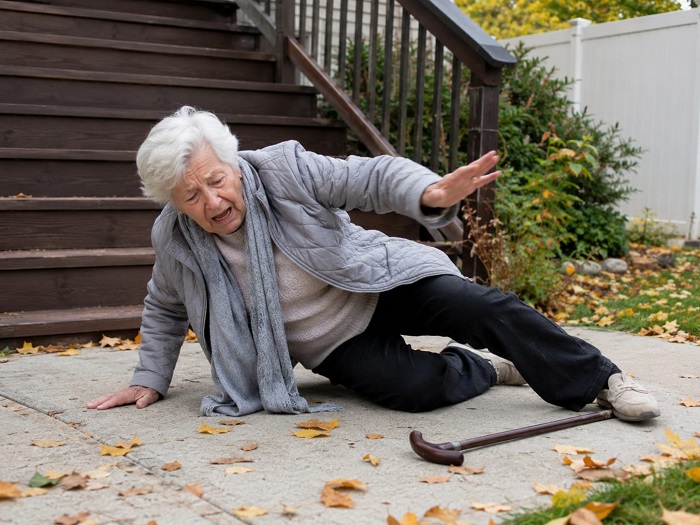
A 2023 systematic review and meta-analysis analyzed 24 randomized controlled trials involving older adults. The researchers reported that Tai Chi was associated with a significantly lower risk of falling. The pooled results suggested a relative fall risk of 0.76, compared with control conditions—approximately a 24% relative reduction in risk within the populations and interventions studied. Tai Chi also improved measures including functional reach, gait speed, single-leg balance, and the Timed Up and Go test.
An earlier meta-analysis involving 18 trials and 3,824 participants similarly found that Tai Chi practitioners had a lower likelihood of experiencing at least one fall and a reduced overall rate of falls compared with control groups.
The evidence is therefore not based on a single experiment. Multiple trials and systematic reviews point in a similar direction.
Why Might Tai Chi Improve Balance?
One possible explanation is that Tai Chi does not train only the muscles.
It trains the relationship between the brain, senses, and movement.
During slow movement, practitioners have time to notice subtle changes in pressure through the feet, ankle position, knee alignment, hip movement, and the location of their center of gravity.
Research provides some support for this sensorimotor explanation.
A 2024 study followed adults between 60 and 89 years old through 16 weeks of 24-form Tai Chi practice. Researchers measured muscle strength, tactile sensation, joint-position awareness, and postural control. After the intervention, participants showed improvements in areas including ankle and hip strength, sensation through parts of the foot, kinesthesia, and aspects of static postural control.
This is especially interesting because balance depends heavily on information coming from the feet and joints.
If the brain receives clearer information about where the body is positioned, it can potentially make better corrections when balance begins to change.
Tai Chi, Proprioception and the Feet
Proprioception is sometimes described as our body’s internal positioning system.
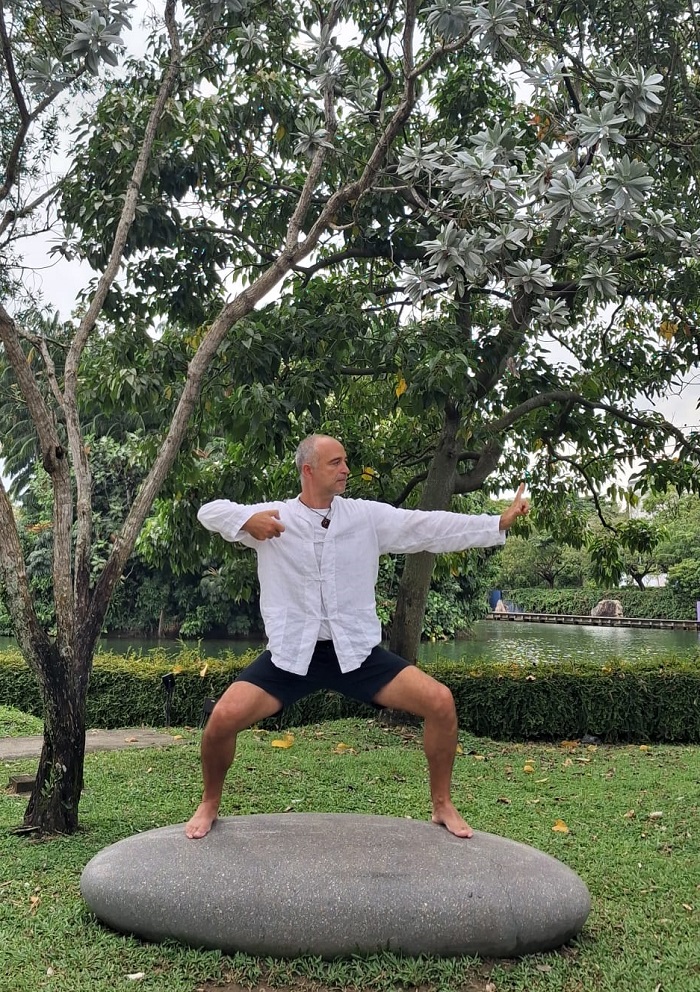
You can close your eyes and still know whether your knee is bent or your arm is raised because receptors in muscles, tendons, and joints continually provide information to the brain.
Tai Chi repeatedly challenges this system.
We slowly load one leg, unload the other, turn, step, sink, and rise. Instead of moving automatically, we are encouraged to feel the movement while it is happening.
A randomized study involving people with knee osteoarthritis found that 24 weeks of Tai Chi produced improvements in several measurements of ankle and knee proprioception compared with health education.
This may help explain why experienced practitioners often appear remarkably stable even though their movements remain soft and relaxed.
Balance does not necessarily require stiffness.
It requires information, awareness, and appropriate muscular response.
Learning to Lose Balance Safely
There is another important principle hidden inside Tai Chi practice.
To take a step, we actually have to surrender our existing balance.
We transfer weight onto one leg, release the other leg, and move it into a new position. The body then establishes a new base of support.
Walking itself is therefore a continuous process of controlled imbalance and recovery.
Tai Chi slows this process down enough for us to study it.
Rather than simply becoming better at standing still, the practitioner becomes more experienced at shifting the center of gravity while remaining under control.
This is closer to the type of balance required in everyday life.
Evidence From Parkinson’s Disease
One of the best-known Tai Chi balance studies was published in the New England Journal of Medicine in 2012.
Researchers randomly assigned 195 people with Parkinson’s disease to Tai Chi, resistance training, or stretching. Participants trained for 60 minutes twice weekly for 24 weeks.
The Tai Chi group demonstrated greater improvements in measures of postural stability than both comparison groups and also showed improvements in several functional measures.
The study does not mean Tai Chi is a treatment or cure for Parkinson’s disease. It does, however, demonstrate how controlled weight shifting and postural training can have measurable effects even in a population where balance is significantly challenged.
Balance Begins With Awareness
Tai Chi gives us an unusual opportunity to study our own movement.
Where is my weight?
Am I leaning?
Am I gripping the floor with my toes?
Is one side of my body carrying more tension?
Can I transfer my weight without collapsing into the knee?
Can I step without falling onto the next foot?
These simple questions gradually develop a more sophisticated relationship between attention and movement.
And this may be one of Tai Chi’s greatest strengths.
We are not merely exercising the legs. We are teaching the nervous system to pay attention to the body while it moves.
A Practice for Life
The strongest research on Tai Chi and balance currently concerns older adults and particular clinical populations, so it is important not to assume that every finding applies equally to every person or age group. Studies also differ considerably in Tai Chi style, teaching method, frequency, and duration.
Nevertheless, the overall direction of the research is encouraging.
Tai Chi combines controlled weight transfer, lower-body conditioning, coordination, proprioceptive training, attention, and postural awareness within a single practice. Modern research is increasingly measuring what generations of Tai Chi practitioners have experienced through practice:
Balance is not created by becoming rigid. It is developed by learning how to continuously adapt.
The objective is not to create a body that never loses balance.
It is to create a body that recognizes change early, responds efficiently, and finds its center again.